

Overview
Our aim is to grow the quality and impact of our globally recognised, innovative and interdisciplinary research.
The Research Excellence Framework (REF) 2029 is fast approaching and we are ambitious in our efforts to grow our research reputation.
Our five research themes provide a basis for interdisciplinarity across individuals and Schools:
- Environment, Energy and sustainability,
- Health and wellbeing,
- Living in a digital world,
- Inclusive and creative societies,
- Pedagogy (to promote collaboration between research and teaching).
Statistics
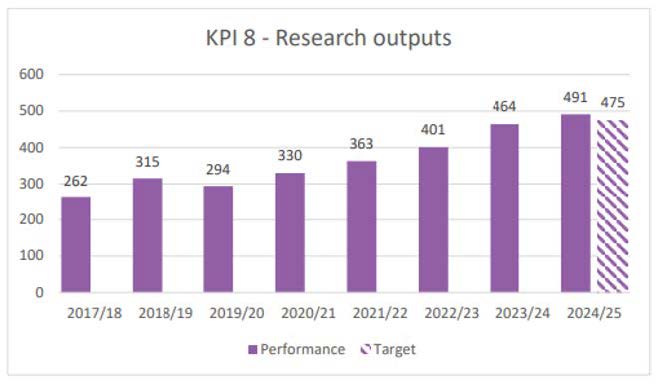
- 491 research publication outputs during the year, generating £3.4m in research grant and contract income.
- 69 successful Postgraduate student completions, comprising 57 PhD, three Professional Doctorate, three PhD by Public Output and six MRes/MScR.
- 90% satisfaction rate from those taking part in Postgraduate research (The Graduate School Postgraduate Research Experience Survey 2025).
Nigerian Petroleum Technology Development Fund (PTDF) – energy doctorate
We strengthened our international collaborations with the launch of a new energy doctoral programme that will enable students to study in both Aberdeen and Nigeria.
The University has signed a Memorandum of Understanding (MoU) with the Nigerian capacity building agency for the energy industry, PTDF – as well as an agreement between the two organisations and the College of Petroleum and Energy Studies, Kaduna (CPESK) – to deliver up to 45 split-site energy PhDs for Nigerian students over the next three years. Students on the three year programme will split their time between the Garthdee campus in Aberdeen and CPESK in Nigeria. The agreement builds on existing partnership with PTDF to increase international doctorial study opportunities for Nigerian students.
Recent research awards for RGU
- £384,00 funding to develop an AI project to support young cancer survivors led by the School of Computing, Engineering and Technology – a small mirror device provides interactive, AI-driven dialogue and personalised health support.
- £1m in UKRI funding received by Dr Gael Morrow in the School of Pharmacy, Applied Sciences and Public Health for research on trauma injuries and uncontrolled bleeding, plus £30,000 funding over three years to look at the haemostatic profile of patients with Endometriosis.
- Gray’s School of Art, in partnership with Duncan of Jordanstone College of Art and Design, has been awarded more than £400,000 from the Arts and Humanities Research Council to lead a research project on Yugoslavian art.
Athena Swan Charter Bronze Award
The University was awarded the Athena Swan Charter Bronze Award in recognition of RGU’s commitment to promoting gender equality across academic, professional, and support roles. The award is also valuable in terms of providing evidence of our commitment to gender equality in research grant submissions.
Knowledge exchange
RGU is recognised for our Knowledge Exchange (KE) achievements and for working closely with industry to meet its needs and to benefit wider society. Some examples include:
Highland Heat Harvesters – recycling wasted heat energy
RGU’s School of Computing, Engineering and Technology collaborated with Highland Heat Harvesters Ltd to design a device to capture wasted heat energy generated from the exhaust/ flue discharge of any heating system in any building. The innovative Recycling Waste Energy System will then recycle the waste and distribute it throughout the building, raising the ambient temperature.
For the project, we collaborated on the development of an innovative oscillating jet nozzle for enhanced cleaning of process pipes and geothermal wells. The nozzle creates 25% higher impact force than conventional nozzles, demonstrating its superior cleaning efficiency. As the nozzle has a larger coverage area, the clean-out process is quicker, conserving water and energy and reducing its carbon footprint. We went on to secure further funding through the DataLab for this collaboration.
The innovation, which will reduce emissions into the environment and save on energy bills, was shortlisted for Innovation of the Year category at the Scottish Knowledge Exchange Awards 2025.
Harbour Energy – engineering scholarship
Harbour Energy donated £15,000 to launch a new scholarship programme at RGU. The Harbour Energy Access Scholarship Programme aims to support females with strong academic credentials in taking their first steps towards a career in engineering and to address patterns of underrepresentation in technical disciplines in the energy sector.
The first two recipients are second-year students, Melanie Beats from Peterhead and Caitlin Esslemont from Banff, both of whom are studying mechanical engineering.
As well as financial support, the students will receive placement opportunities with Harbour Energy and technical mentoring from the company.
PlanSea – subsea decommissioning
AIdemonstrator PlanSea, which offers world-leading marine logistics artificial intelligence (AI) technology, and RGU’s National Subsea Centre (NSC), a centre of excellence for subsea research and technology development, jointly completed the development of a subsea decommissioning optimisation software demonstrator.
This project is a move towards the digitalisation and optimisation of offshore operations in the £21bn UK market. It will also reduce costs and emissions. The robust software demonstrator can ingest decommissioning data from multiple sources and then use an AI-enhanced scheduler to optimise fleet and resource allocation whilst integrating expert insights and feedback into operations modelling.
PlanSea is now engaging with the sector to deliver this service on a global consultancy basis, both for operator strategic planning and contractors seeking to optimise fleet and other resources.
The Energy Transition Institute
RGU’s Energy Transition Institute (ETI) has been a central component of the University’s contribution to working with the industry in the North-East of Scotland to help shape the future skills requirements of the offshore workforce and the supply chain, and establish the region as a global energy hub in a green economy.
In June 2025, ETI launched a major new report “Striking the Balance: Building a sustainable UK offshore energy workforce”. The report offered analysis and insights into the future of the UK’s offshore energy sector and underscored the urgency for action and collaboration across sectors to protect jobs, sustain the worldclass offshore energy supply chain, and accelerate the transition to a greener and cleaner future. The report, widely quoted in the national media and cited in Holyrood and Westminster debates, forecast that the UK oil and gas workforce will fall from 115,000 to between 57,000 and 71,000 by the early 2030s, and the Scottish-based offshore energy workforce decrease from around 75,000 to between 45,000 and 63,000.