
Multi-stack tubular solid oxide steam electrolyser (T-SOSE)

Solid oxide steam electrolysers (SOSE) are a promising type of technology of hydrogen production with the potential to be a part of the sustainable future of the energy sector. The research proposes to improve the efficiency of SOSE by modelling, manufacturing and testing the electrolysis cell using a tubular design.
Research Opportunities
Summary
The proposed studentship proposal is being submitted to complement and continue with the research on solid oxide electrolyser funded by EPSRC (EP/W033178/1).
Ongoing geopolitical conflict and challenges mean that hydrogen production technologies (e.g., electrolysers) will need to be developed and deployed at an even faster pace than before, as energy security is necessary for everyone. The current focus is on the deployment of first-generation technology solutions at small scale to meet short and medium-term targets. An example of this is the ambition to install 6 GW of electrolysis by 2024 and 40 GW by 2030, as set out in the European Commission Hydrogen Strategy (A hydrogen strategy for a climate-neutral Europe, 2020). Addressing materials and manufacturing related issues in electrolyser electrodes will be an essential enabler for the further roll-out of hydrogen for net-zero, and the proposed research will address such issues.
Aims
Manufacturing solid oxide steam electrolysers (SOSE) can present several challenges due to the complexity of their design and multi-materials/multi-layer structure involved. In the first phase of METASIS research, the challenges addressed included materials selection and optimising the manufacturing of cathode, electrolyte, and anode layers on porous metallic (stainless steel, titanium) tubes. Manufacturing techniques such as dip coating, electrochemical deposition, and thermal spray coating were used to deposit various layers on porous metallic tubes. Additionally, we increased the catalyst surface area through creating a meta-surface (providing enhanced active sites), a novelty in the field of SOSE electrode manufacturing. The key outcome showed that the tubular electrolyser cell provides improved performance, i.e., achieving a current density of 3.5 A/cm2 at 1.2 V and 400 °C. The research aims to further enhance design, develop materials, and investigate other functionality, leading to more efficient and durable tubular electrolyser electrode systems. The proposal will investigate tubular solid oxide steam electrolyser (T-SOSE) electrode assemblies (Fig. 1) manufactured using scalable techniques (e.g., thermal spray coating, dip coating).
Methodology/tasks
Apart from thorough literature review, key tasks are:
- Task 1: Tubular SOSE modelling (thermomechanical/computational fluid dynamics modelling using ANSYS/COMSOL).
- Task 2: Anode, electrolyte, and cathode layer manufacturing (e.g., dip coating, screen printing, thermal spray coating), and process optimisation,
- Task 3: Structure-property-characterisation-performance testing of electrodes (XRD, SEM, EDS),
- Task 4: Electrolyser testing (EPSRC funded METASIS (EP/W033178/1) project resources will be used).
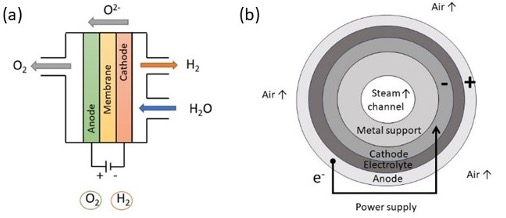
Fig. 1. Solid oxide electrolyser cell schematic: (a) basic electrochemistry of the solid oxide electrolysis process, and (b) general view on the tubular cell with a thick metal support.
Impact
SOSE is not widely available, and once such electrolyser is developed, integrating such electrolyser with power plants will leverage existing infrastructure and expertise in high temperature electrolysis technologies. Industrial sectors where large amounts of heat energy are available (e.g., nuclear, solar thermal plants, geothermal plants, steel plants, ammonia and methanol production plants, paper mills, petrochemical plants) will also benefit. It will contribute to delivering UKRI’s Engineering Net Zero (ENZ) priority, as outlined in objective 5.1 of the Strategic Delivery Plan (2022-25), i.e., developing the technological solutions which will decarbonise our economy and society to create a sustainable net zero future.
Specific knowledge/skills required by student (if any)
- Experience in ANSYS/COMSOL
- Materials characterisation and testing
- Electrochemical testing
- High temperature electrolysis
Supervisors
Discuss this further with a potential supervisor for this research degree:
Research Themes
Find other Research Degrees in the same theme:
Entry requirements
Fees & Costs
How to Apply
Any questions?
Get in touch with our team and we'll do our best to help.
Ready to start this Research Degree?
Find out about our entry requirements, application dates and how to apply.