
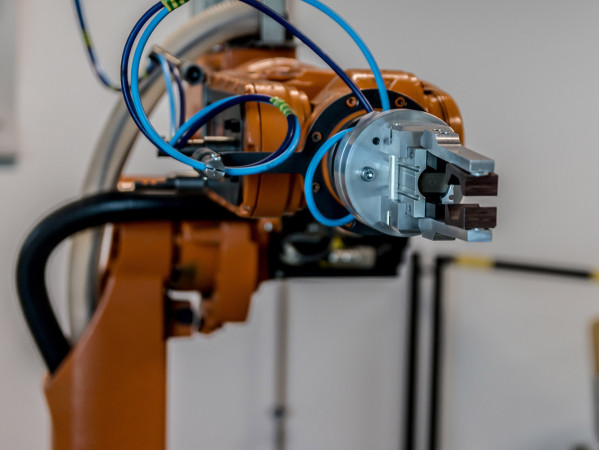
The Robotics Engineering MEng provides a broad and detailed education in designing and deploying intelligent robotic systems. It brings together mechanical, electrical, and computing disciplines, with practical, project-focused work embedded from the start.
Students build from core engineering principles into advanced topics such as control, AI, and machine vision, supported by modern facilities and strong industrial links. The extended MEng pathway allows students to explore more advanced research-led material and higher-level system challenges, supporting progression into technically demanding roles within robotics and automation.
The integrated MEng pathway extends learning through research, professional development, and complex system design, preparing graduates for leading roles in robotics and automation.
Year 1
Stage 1 is common across all engineering degrees and provides a rigorous foundation in mathematics, physics, programming, and electrical and mechanical systems. Students on the MEng Robotics pathway are encouraged to engage with greater depth and independence. Through hands-on labs and collaborative design challenges, you'll apply theory in practical contexts while developing analytical, communication, and problem-solving skills-forming a strong platform for advanced study in robotics and intelligent systems.
Year 2
In Stage 2, you'll deepen your core knowledge through a blend of general engineering modules and robotics-specific topics such as embedded systems, control, and automation. You’ll also select from a range of electives offered across the School, enabling you to shape your learning to suit your interests. For MEng students, this stage provides opportunities to explore more complex concepts and lays the groundwork for placements or study abroad after successful completion.
Year 3
In Stage 3, you'll further advance your expertise through specialist robotics modules, with particular focus on control systems, machine vision, and artificial intelligence. These are complemented by general engineering subjects and a choice of electives from across the School. MEng students are expected to demonstrate a higher level of critical thinking and independence as they apply their skills in increasingly complex contexts-preparing for the technical and professional demands of modern robotics.
Year 4
In Stage 4 of the MEng, Semester 1 combines an independent research project with dedicated modules in professional and technical skills development, including project management, ethics, and communication. These experiences prepare you for leadership roles in engineering. Semester 2 follows a structure similar to Stage 3, offering advanced robotics modules alongside elective options-allowing you to deepen your expertise and shape your learning to match your interests and career goals.
Year 5
Stage 5 offers full immersion in robotics, with Semester 1 focused entirely on specialist and elective modules tailored to your interests and career goals. You’ll explore advanced topics at the cutting edge of robotics and automation. In Semester 2, you'll undertake a substantial individual capstone project, applying your knowledge to solve a real-world engineering challenge-demonstrating your innovation, technical ability, and readiness for professional or academic advancement.
Events
We have on campus and virtual events to help you find out more about study, student experience and future career paths.
Learning Methods
Teaching and assessment on the Robotics & Mechatronics course are built around active, project-based learning, designed to reflect real-world engineering practice. You’ll engage in hands-on labs, team-based design challenges, and industry-informed projects that develop both technical and professional skills.
Assessment methods include practical assignments, group work, presentations, and coursework, with minimal reliance on traditional exams. Emphasis is placed on creativity, critical thinking, and problem-solving, helping you build a strong portfolio of experience. Collaborative learning, peer feedback, and interdisciplinary projects ensure you're prepared not just to understand robotics, but to innovate within it. Learning is supported by expert staff and cutting-edge facilities.
Access to our virtual learning environment, Moodle, is also provided giving you access from home to learning materials (including videos, e-books and journals).
How long is a Robotics & Mechatronics course?
The MEng Robotics & Mechatronics degree can be successfully completed in 5 years, in which the opportunity to receive the necessary skills are obtained.
Activity Summary
You will generally study four modules each Term, each varying in contact type. Typically you will have 3 hours per-module per-week in a mixture of lectures to the whole class, tutorials, laboratories, workshops and computer laboratories to learn specialist software.
Your course resources will be available on Moodle, where you will find course notes, tutorials, coursework assignments and much more.
Year 4
- Lectures - approximately 20 students per group, 3 hours per week
- Practical class or workshop - approximately 20 students per group, 9 hours per week
- Independent study - 30 hours per week
Independent Study
Independent study forms a major part of each module, allowing you to deepen understanding through guided reading, problem-solving, and project work. You’ll consolidate material from lectures and labs, prepare for assessments, and explore specialist topics, developing the self-directed learning and critical thinking skills essential for professional engineering practice.
Assessment
Assessment methods include practical assignments, group work, presentations, and coursework, with minimal reliance on traditional exams.
Typically students are assessed:
Year 1
- 6 portfolios
Year 2
- 8 portfolios
- Capstone project
Staff Delivering on This Course
The Robotics Engineering course is delivered by an experienced team of academics, researchers, and professional engineers with expertise spanning mechanical design, electronics, control systems, artificial intelligence, and autonomous systems. Many staff are active researchers engaged in cutting-edge projects in areas such as renewable energy, subsea robotics, and intelligent manufacturing, ensuring teaching is informed by the latest technological developments. The team maintains strong partnerships with local and international industry, bringing real-world insight into the classroom. Students benefit from a supportive and collaborative environment where approachable staff provide academic guidance, technical mentorship, and opportunities for research and professional engagement.
Feedback
We aim to provide you with feedback within 20 working days of submission of coursework.
Academic Support
The Inclusion Centre advises and supports students who disclose a sensory or mobility impairment, chronic medical condition, mental health issue, dyslexia and other specific learning differences. Applicants are encouraged to arrange a pre-entry visit to discuss any concerns and to view the facilities.
Online Learning & Support
All undergraduate and postgraduate students, whether you are learning on campus or by online learning, benefit from using our collaborative virtual learning environment, CampusMoodle. You will be provided with 24/7 online access to your learning material and resources, along with the ability to interact with your class members and tutors for discussion and support.
Study Skills Support
The Study Support Team provides training and support to all students in:
- Academic writing
- Study skills (note taking, exam techniques, time management, presentation)
- Maths and statistics
- English language
- Information technology support
Library Support
The Library offers support for your course, including the books, eBooks, and journals you will need. We also offer online reading lists for many modules, workshops and drop-ins on searching skills and referencing, and much more.
Placements
Placements are a key part of the MEng Robotics course, offering vital industry experience. In the standard five-year route, students may undertake a 12-month placement, which provides practical insight but is largely formative rather than assessed. Fast-track four-year MEng students complete two summer placements, both fully assessed as part of the course, giving structured opportunities to develop professional skills. These placements expose students to cutting-edge robotics, automation, and AI technologies in leading companies. Experiences gained inform final-year independent study, enhancing employability, technical understanding, and real-world project experience.
What is needed for the MEng Robotics & Mechatronics course?
Standard Entry Requirements
- SQA Higher: BBBC to include Maths and either Engineering Science, Chemistry, Physics or Technological Studies. English at National 5 grade C or above is required if not held at Higher.
- GCE A Level: BCC to include Mathematics and one from Physics, Design Technology, Electronics, Chemistry or Engineering. GCSE English at grade 5/C or above is required if not held at A Level.
- Irish Leaving Certificate Higher: H2H3H3H3 to include Maths and either Physics, Chemistry or Technological Studies. English at grade O3 or above is required if not held at Higher.
- IB Diploma: 27 to include Higher Level Maths and either Physics or Chemistry, one of which must be at grade 6 and one at grade 5. English is required at a minimum of Standard Level grade 4
Minimum Entry Requirements
The minimum entry requirements for widening access applicants are:
- SQA Higher: BCCC to include Maths and either Engineering Science, Physics, Chemistry or Technological Studies. English at National 5 C is required if not held at Higher.
Alternative Qualifications
We welcome applications from those with equivalent qualifications to those stated, including SVQs/NVQs, access programmes, Foundation Apprenticeships and overseas qualifications. Applications from students with non-standard qualifications or work experience will be considered on an individual basis.
Applicants from Partner Colleges
Appropriate HNC or HND may allow entry to Stage 2 or Stage 3. These are considered on an individual basis.
English Language Requirements
Applicants whose first language is not English should have an IELTS of 6.0 overall, with no component lower than 5.5, or an equivalent.
We accept a variety of in-country and secure English language tests, find out more:
Please note, some courses may require a higher standard of English than stated in this page. Contact admissions@rgu.ac.uk for further information.
Additional Costs
Some other costs are not included in the course fees:
- The cost of books that you may wish to purchase.
- Costs associated with any placement / study abroad
- Accommodation and Living Costs
- Printing
Student Funding
If you are a Scottish resident, you may be eligible for funding and should apply to SAAS for funding.
Students from other parts of the UK should visit the appropriate website:
Scholarships and Financial Awards
You may qualify for a scholarship or financial award:
Disclaimer
For new intakes, course fees are reviewed and published annually for each mode of delivery. Tuition fees are fixed for the duration of a course at the rate confirmed in the offer letter. For further information:
Any questions?
Get in touch with our Student Admissions Service and we'll do our best to help.