

Getting started
What we expect from applicants
Gray’s will enable you to develop your knowledge and a wide variety of skills, so we want to see your potential as an individual and understand how you will embrace the opportunity to study and flourish on campus.
What to include in your UCAS application statement
Provide some background on your experiences and insight into your personal interests and ambitions. We like to hear how you engage with and are informed by the broader cultural world within your application. There is no right or wrong, but we do want to get a sense of your motivations and the reasoning for your application. We want to hear how current topical issues, subjects or themes influence you and the questions you are asking and considering. Also reflect on how any of your other courses or qualifications may have influenced your thinking e.g. English, Modern Studies, RMPS, Sociology, Psychology, Business Management and/or HNC’s & HND’s.
What to include in your digital portfolio
Entry to Foundation in Art & Design course requires a digital portfolio as part of your submission (a maximum of 25 slides) which forms an important aspect of your application. This also applys to advanced entry applications for:
BA (Hons) Communication Design - Graphics, Illustration, Photography
BA (Hons) Fashion and Textile Design - Fashion Design, Textile Design
BA (Hons) Product, Ceramics and Jewellery
BA (Hons) Fine Art - Painting, Photography, Printmaking, Sculpture, Moving Image
Your portfolio should demonstrate aspects of your creativity. We want to see evidence of your skills and abilities but also your interests and aspirations. It should demonstrate your enthusiasm and commitment towards the course and subject area that you’ve applied to.
You can include work from the various qualifications that are eligible within the entry requirements including Art and Design, Photography or Media. Also, projects and work from Design & Manufacture, Graphic Communication, Fashion and Textile Technology and Computing Science.
There is no such thing as the ‘perfect portfolio’ but it should represent ‘you’ as an individual. Include drawings, sketchbook pages, photographs, digital art or design work. Photos and videos of 3D work, sculpture, textiles, experiments and tests are also valuable and helpful. We want to see examples of your thinking and processes. What or who inspires you, where your ideas come from, how you develop them by experimenting developing and improving outcomes and solutions. It should show us the breadth of your inquiry and the depth of your investigation. This can be shown through any combination of documented visual work and/or associated activities.
Above all, your application should convince us about your ambitions and potential.
Your sketchbook
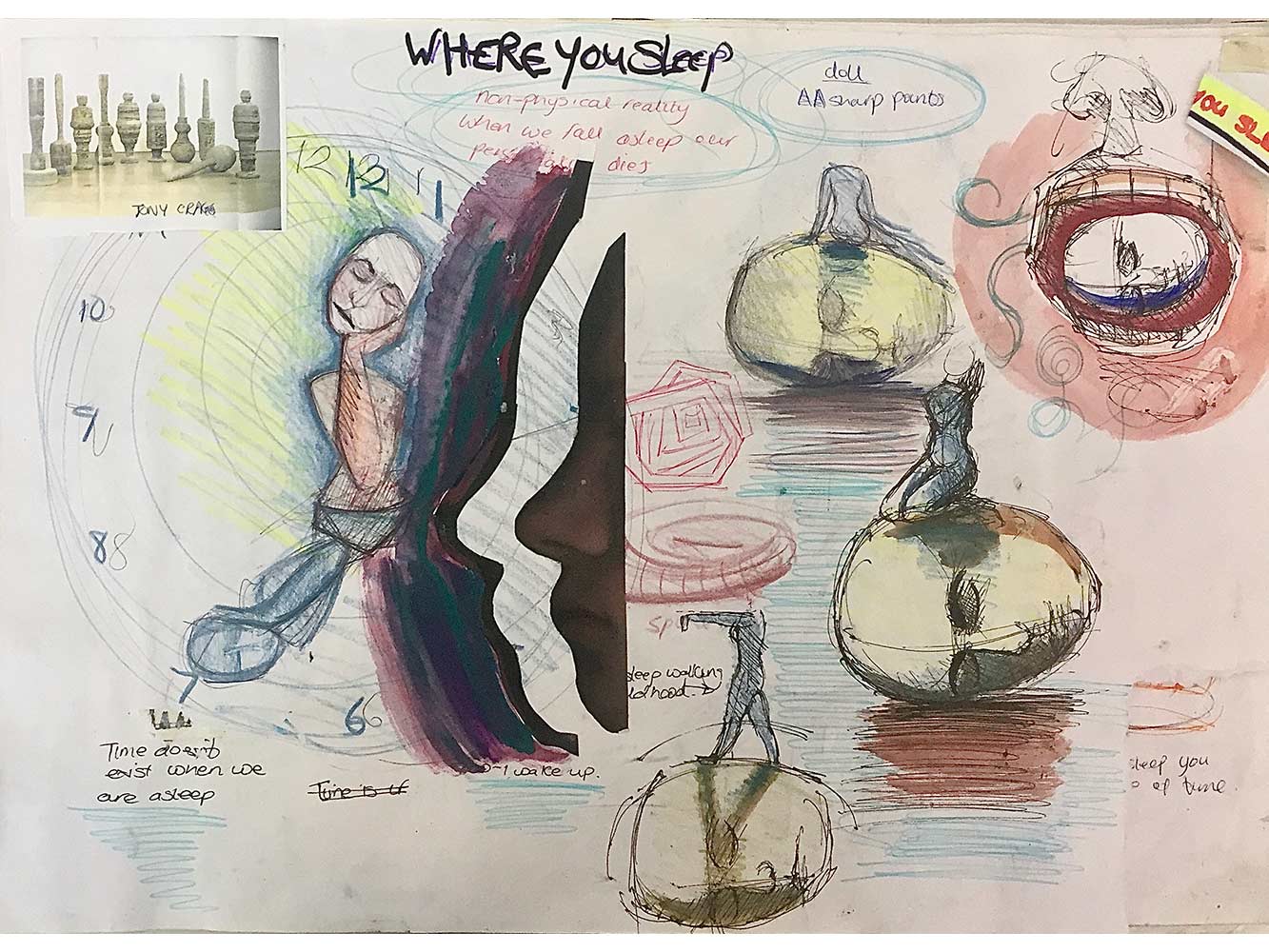
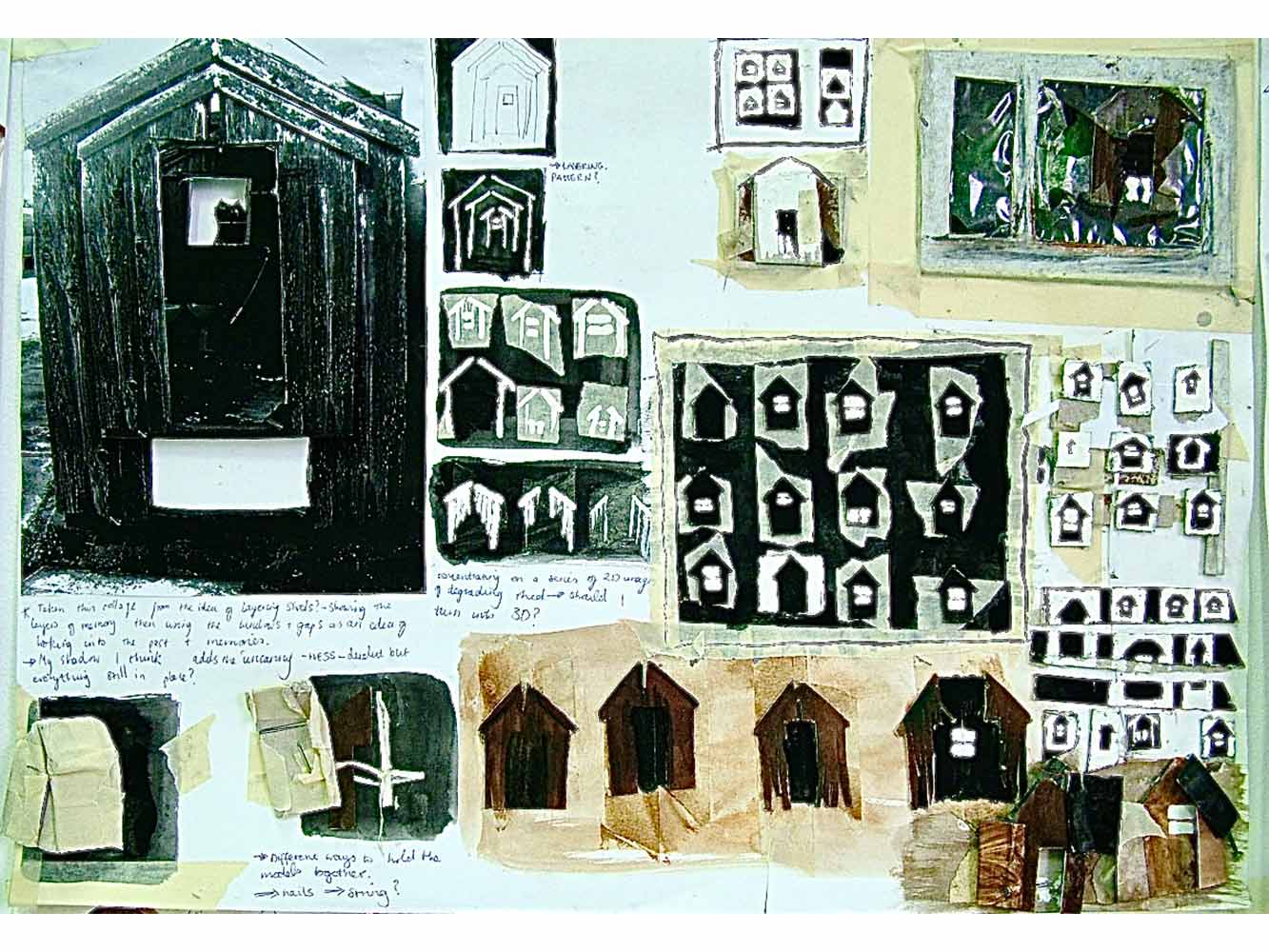
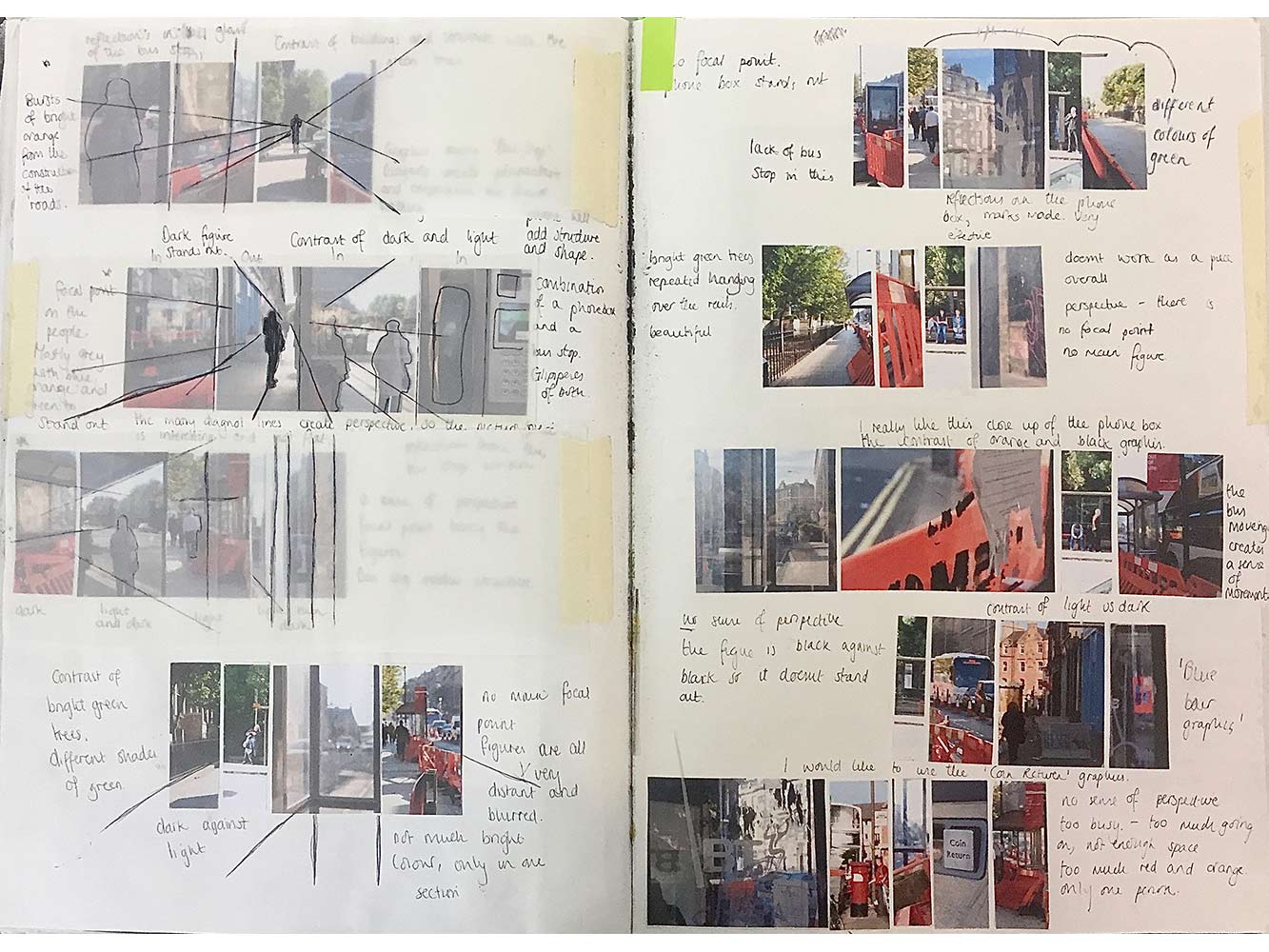
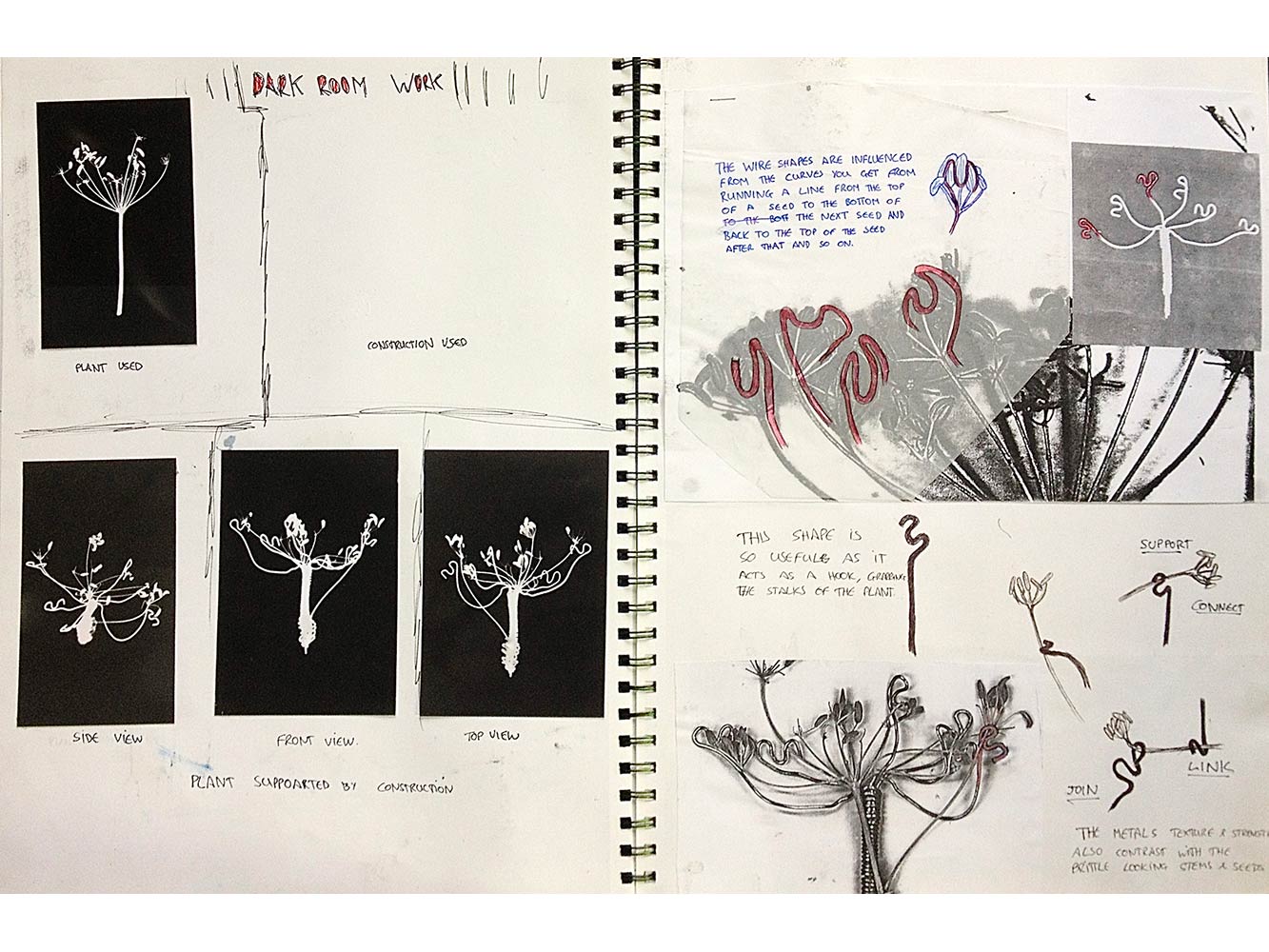
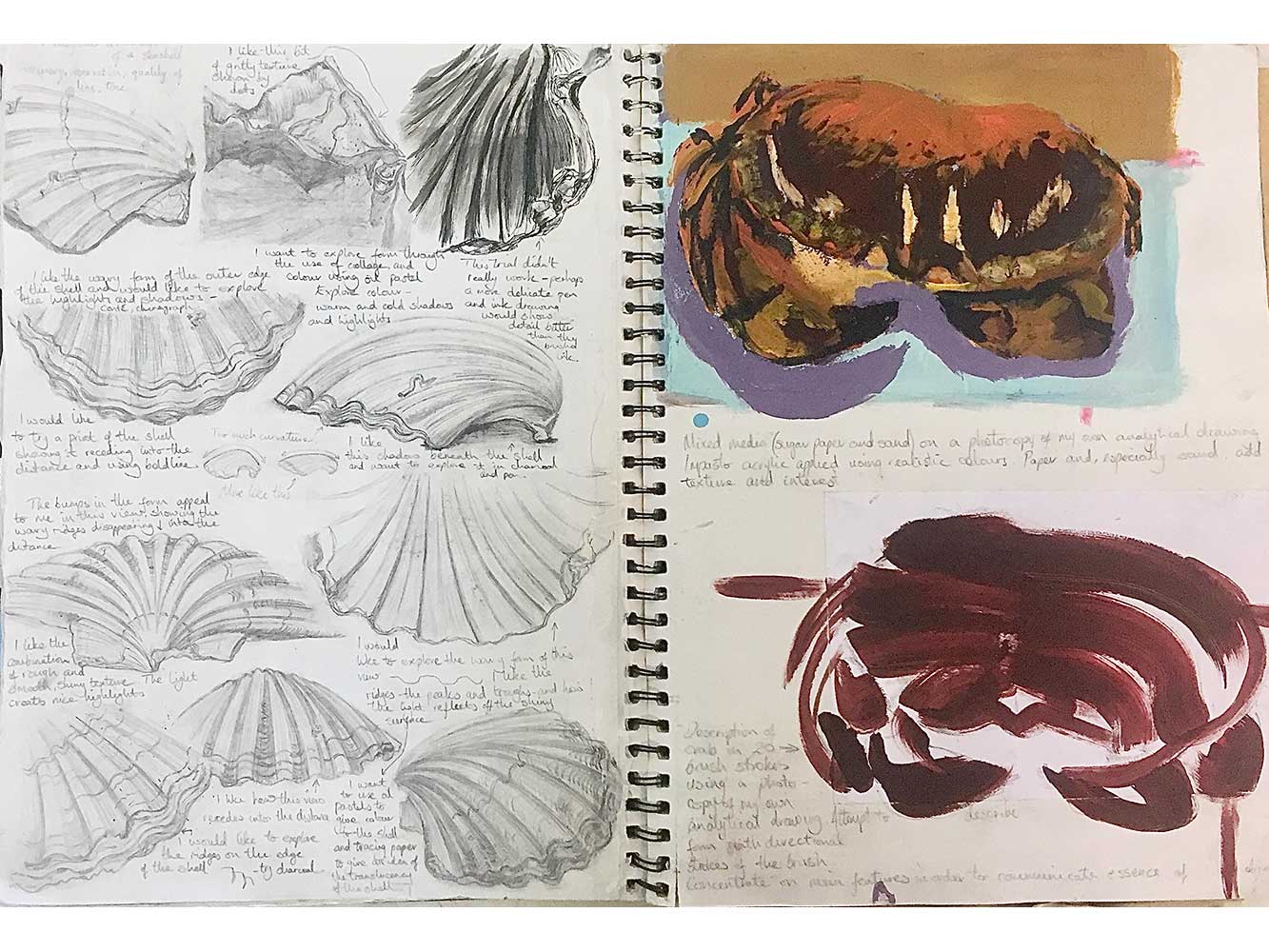
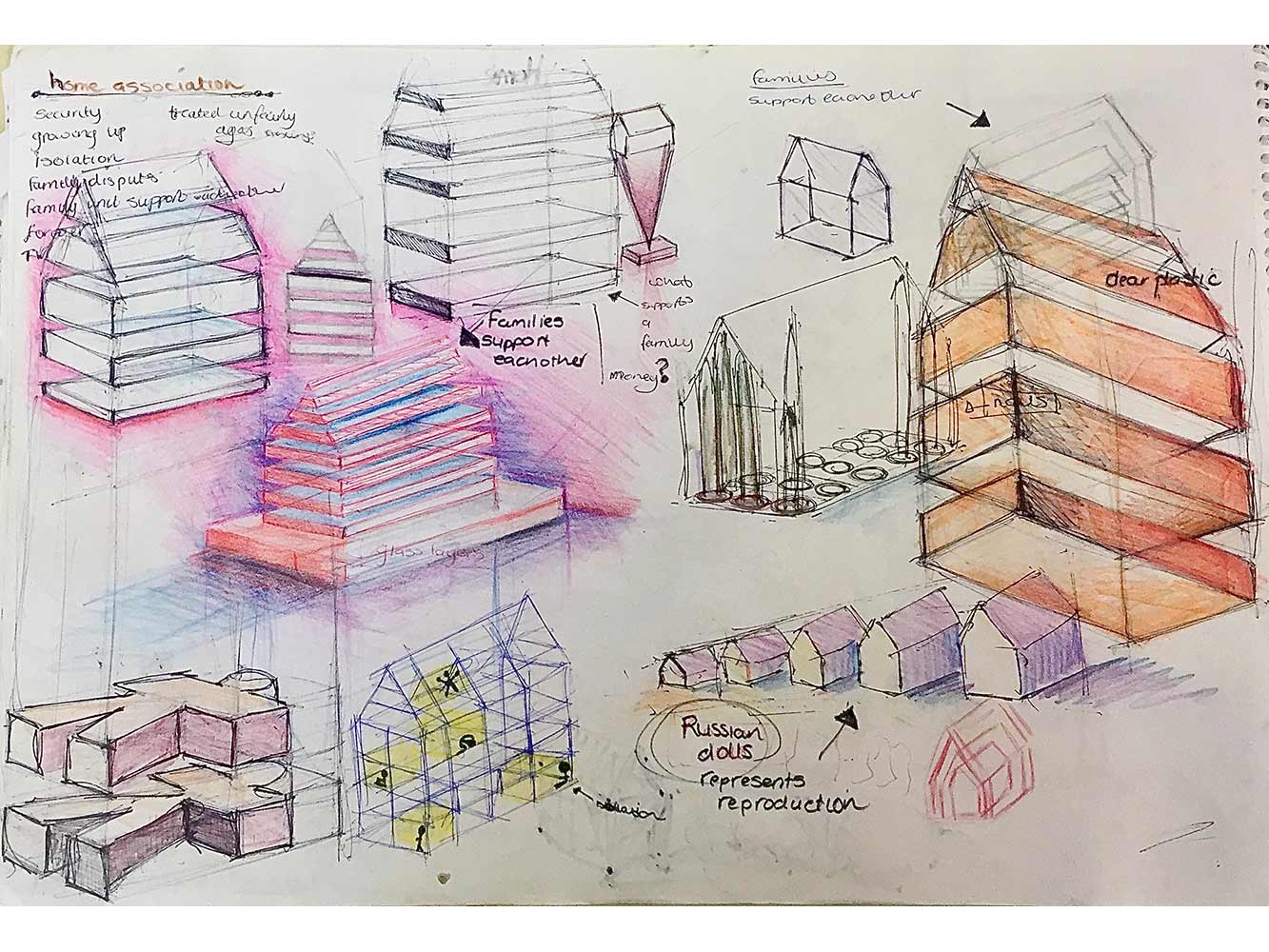
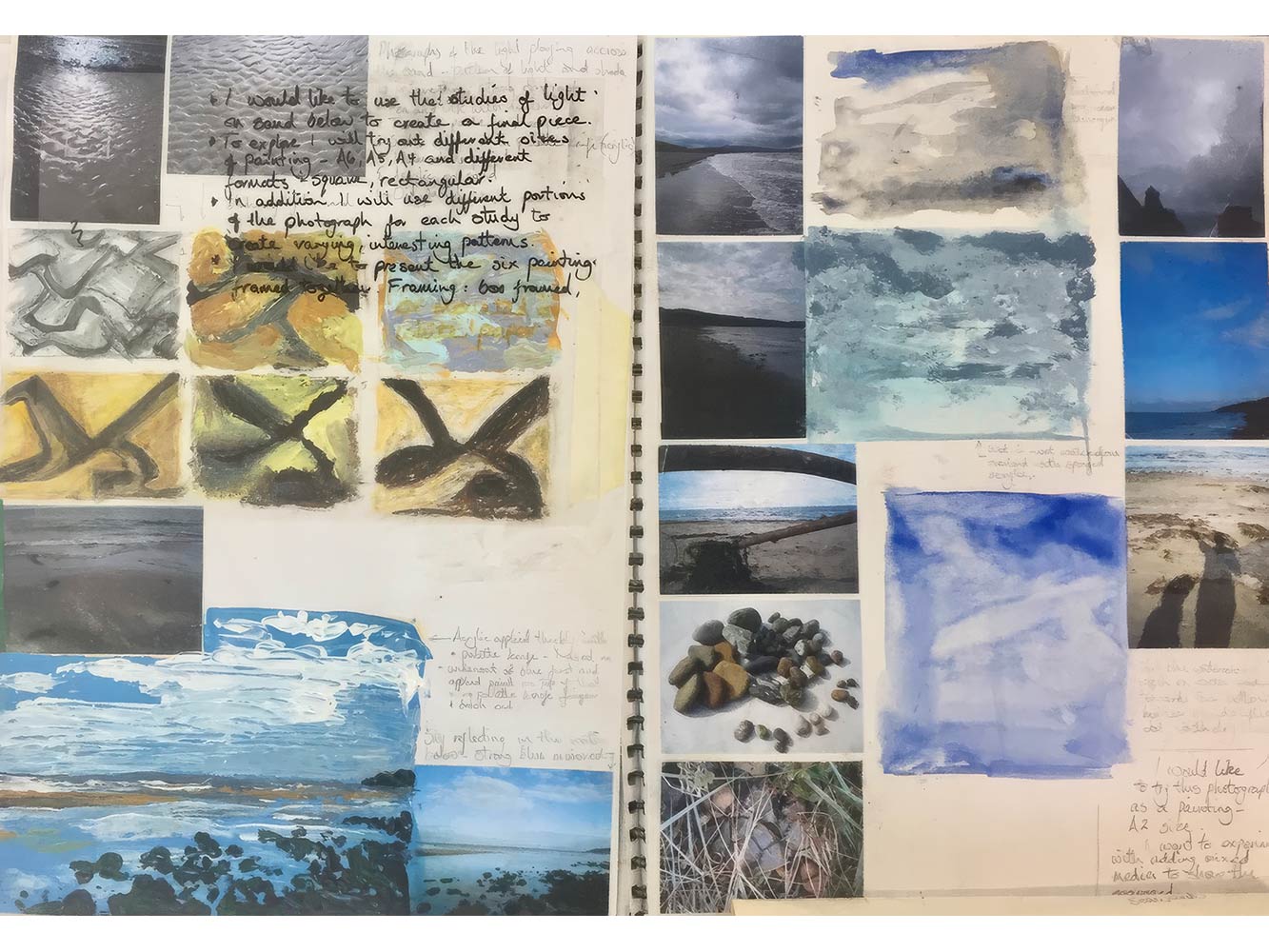
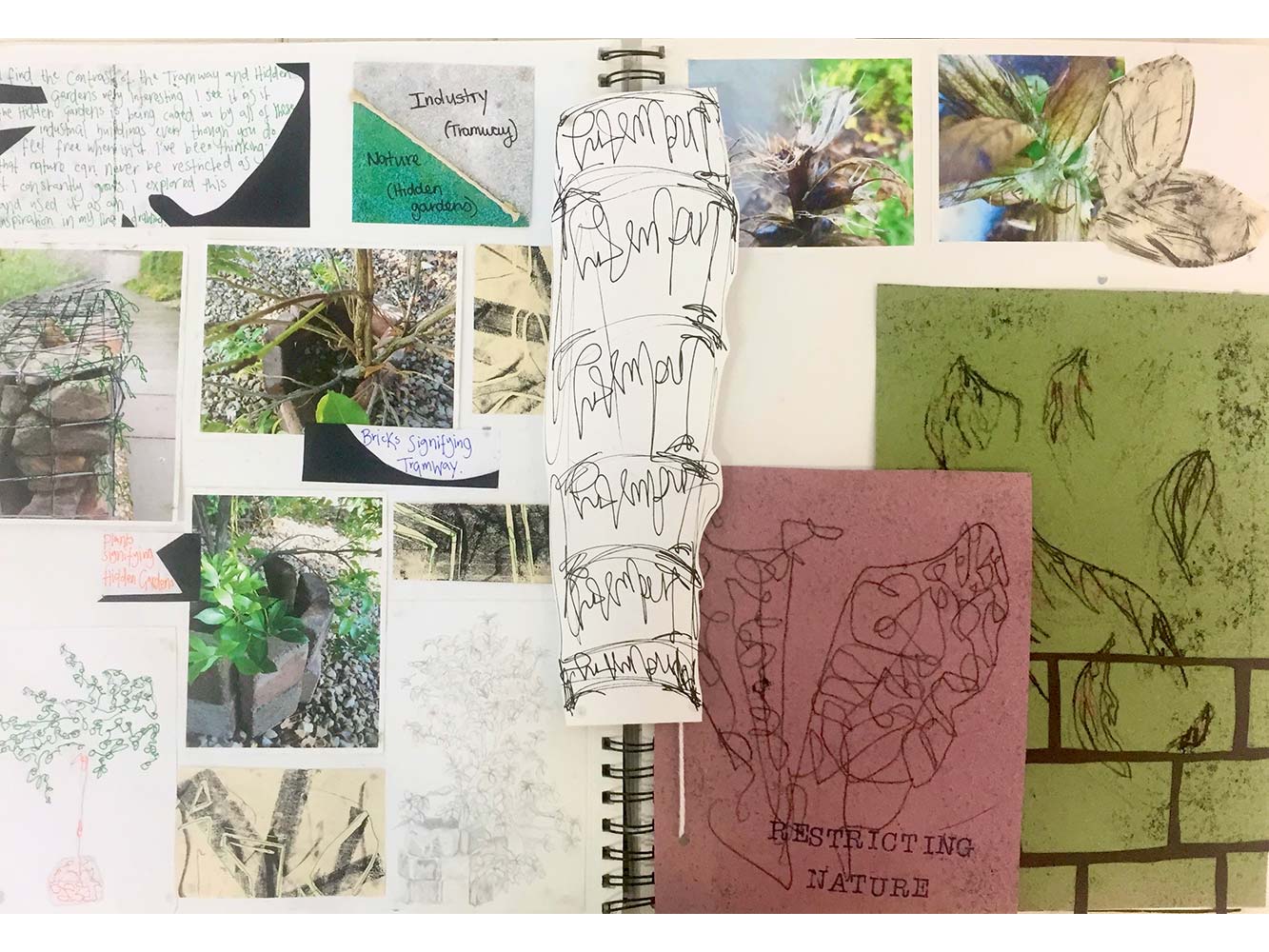
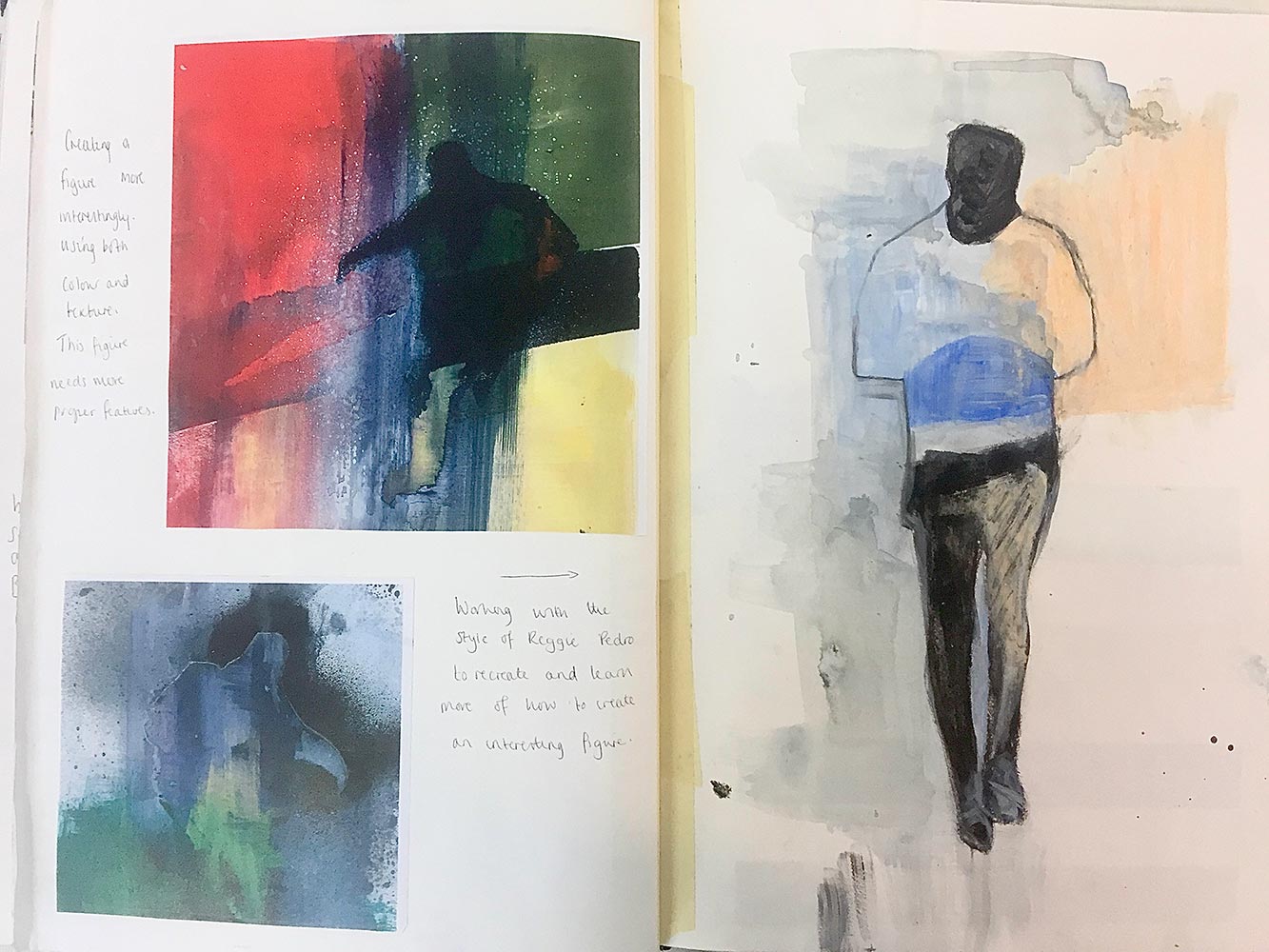
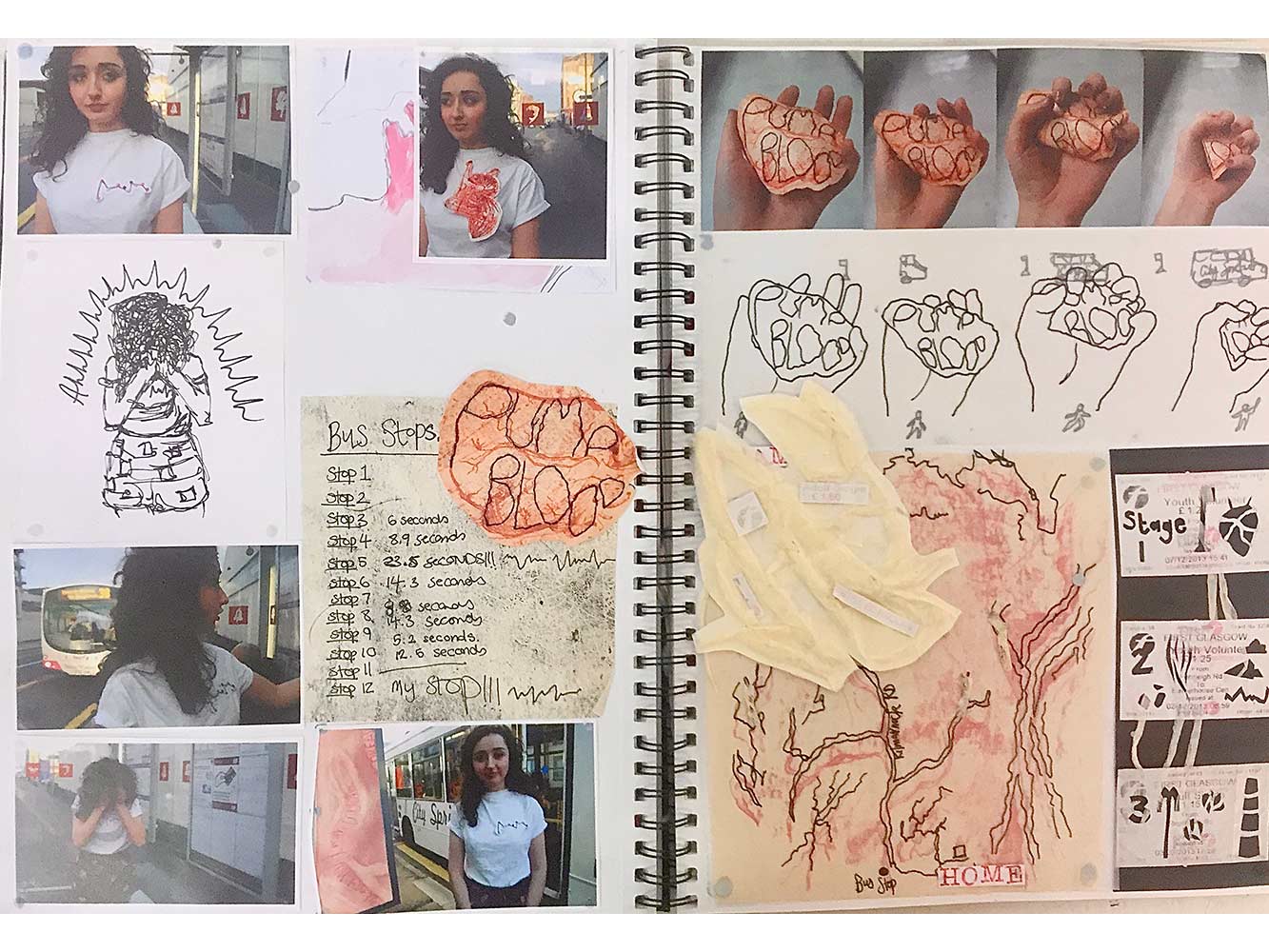
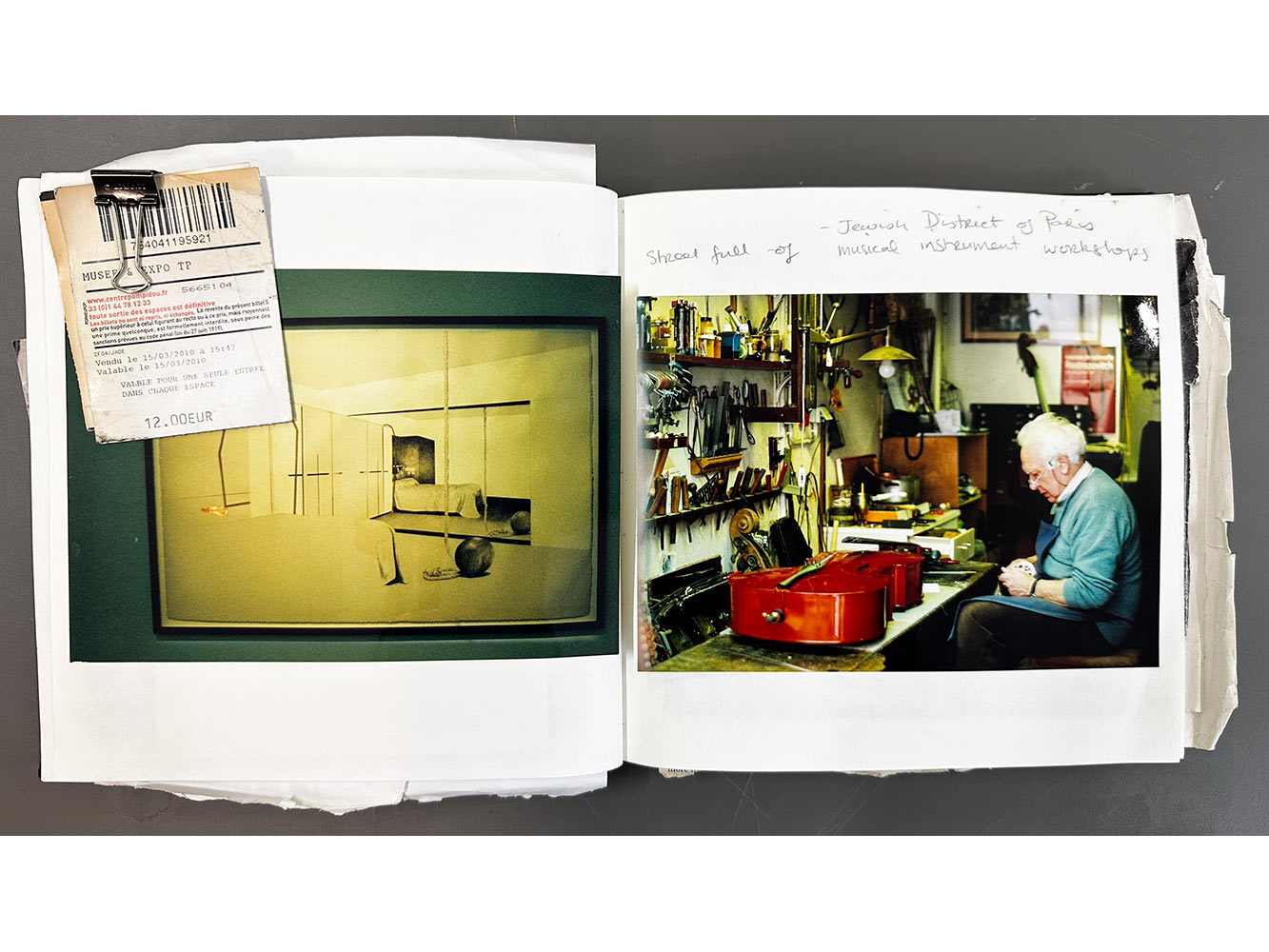
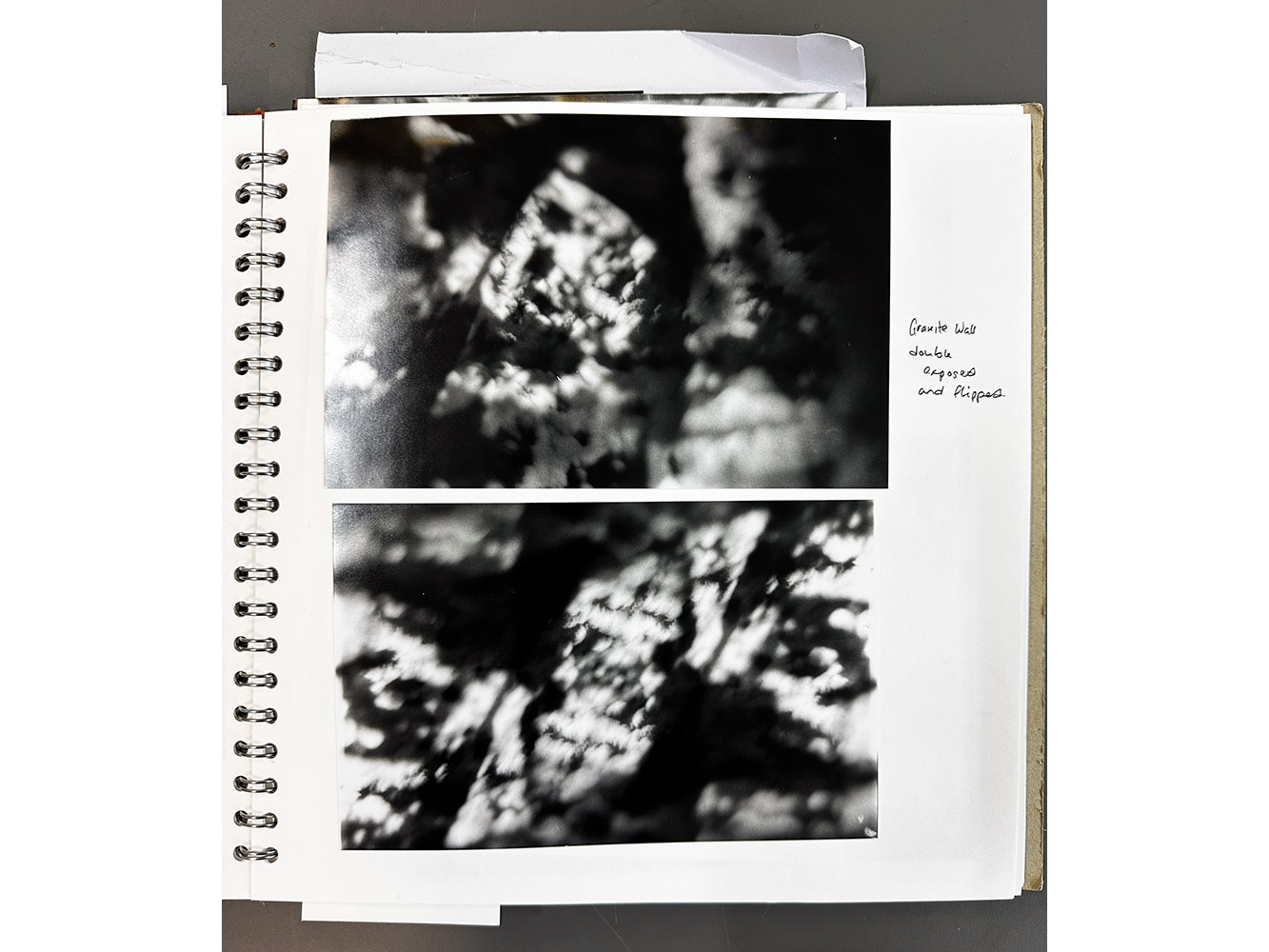
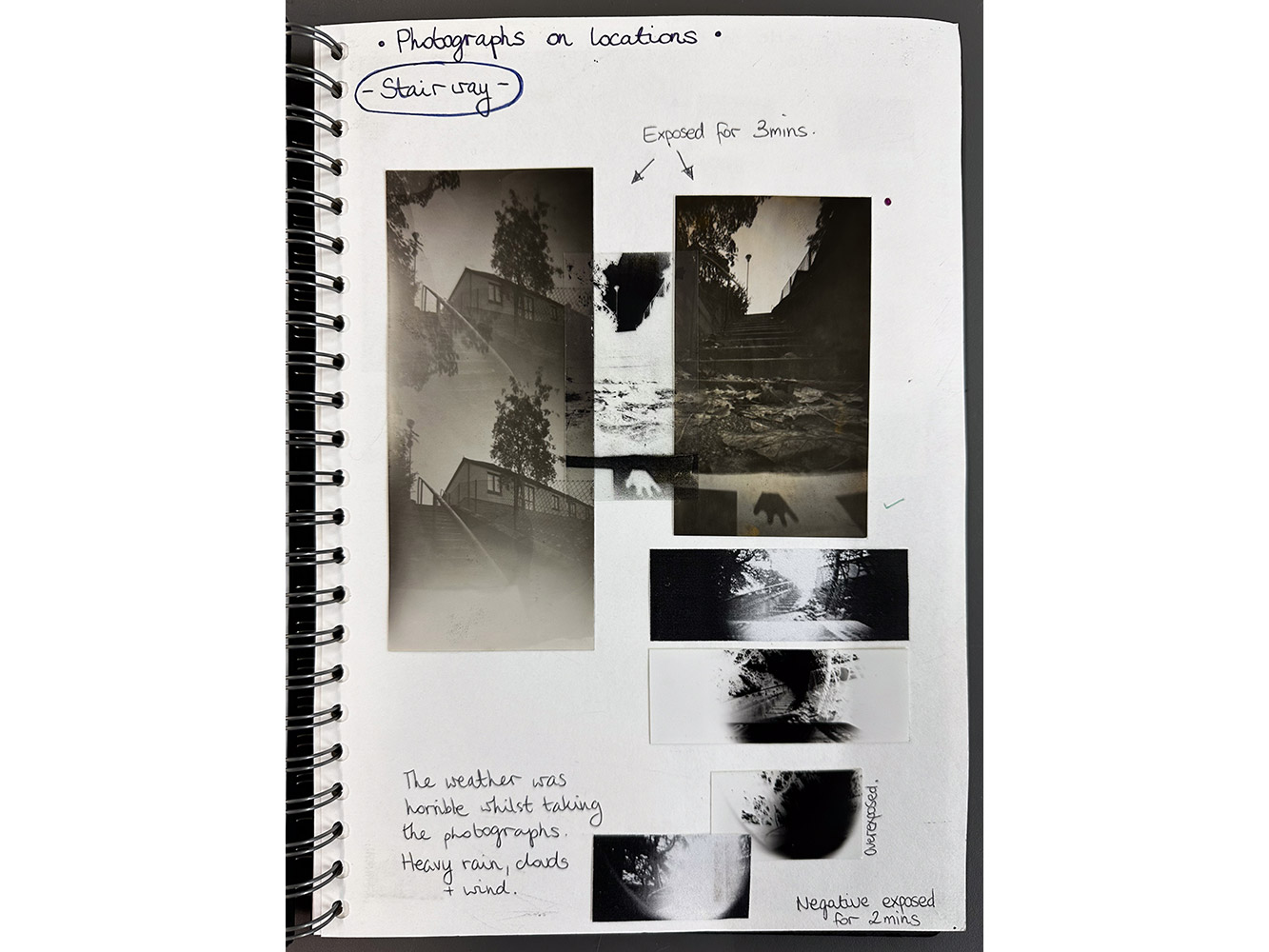
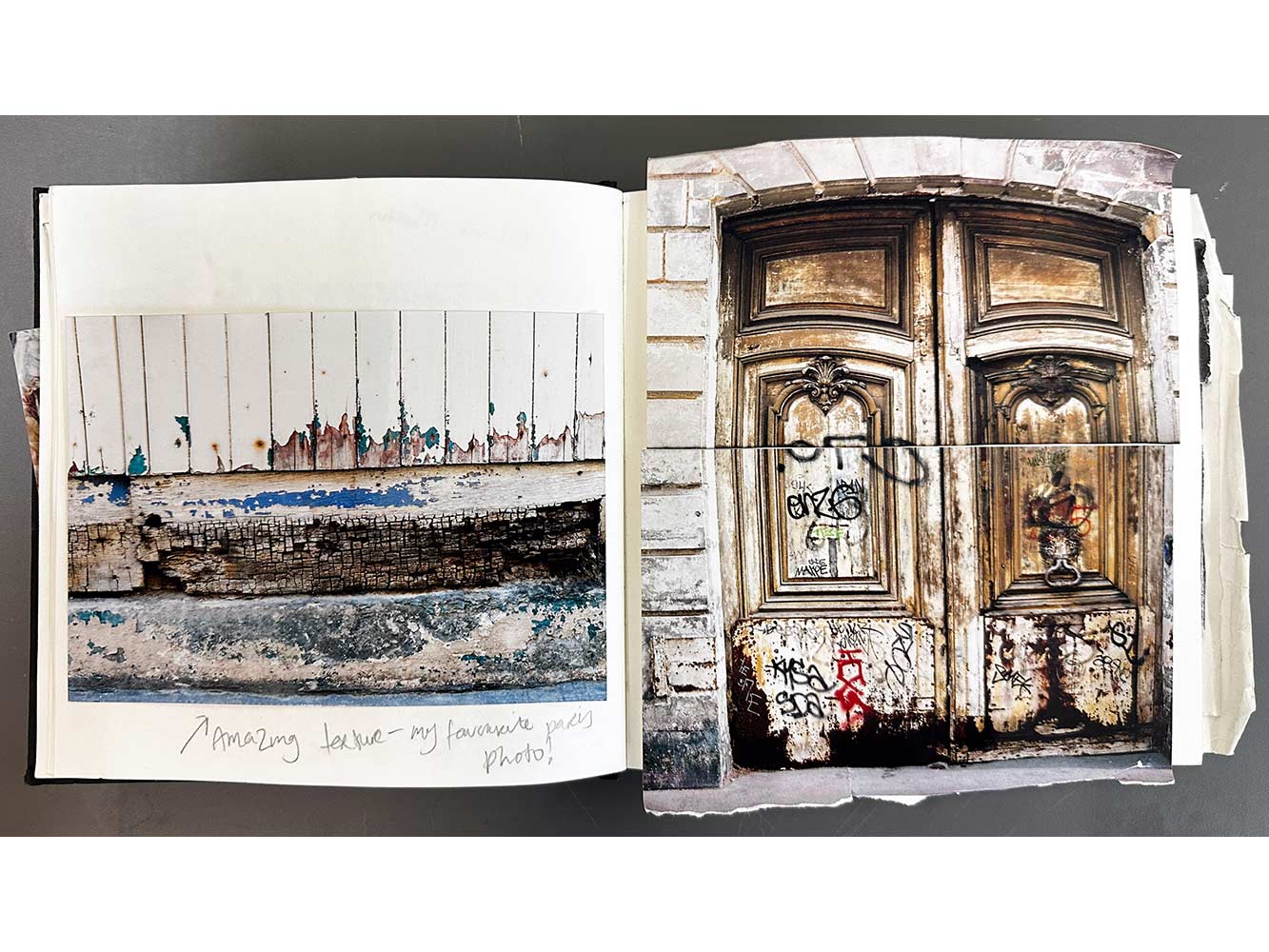
Sketchbooks are a great way to show your engagement.
Try to explain sketchbooks and worksheets with the ideas you are exploring and the options you are trying out.
There is also an opportunity with each slide you upload to elaborate on its visual qualities. Don’t just describe what we can already see, give us some more information about the why behind the work. Is it something you are passionate or angry about? Where did the inspiration start? What did you find out or learn as you made it?
Tip: Photographs (or videos) of your sketchbooks are key to communicating this.
Example Sketchbooks
General
Photography
What to avoid
- Don’t draw from photos unless essential.
There are times you must work from photos but keep it to a minimum and work directly from source when possible. - Don’t copy directly from others work, characters etc.
Try to show us your interpretations or original thinking whenever possible. Influences are very important but at this stage you should be able to show us your own work and style.
Remember to be you…. there is no perfect portfolio, but you do need to demonstrate your potential and ambitions.
Exhibiting your ideas and mindset
So that is the practical side of “what should I include in my portfolio”. But what about the ideas and mindset you should be exhibiting?
- The Curious Dreamer
- The Visual Problem-Solver
- The Reflective Communicator
Portfolio Review
The application is not just about showing skills. Whatever course you are applying for, the team considering your application will be looking for certain creative attributes and behaviours.
Our approach to reviewing your portfolio rewards ambition and behaviours and does not necessarily just focus on skills and techniques which can be restricted by limited access to facilities.
Being someone who is able to be both imaginative and practical is a good mix if you want to thrive in the Creative Industries. There are 3 key attributes we want you to exhibit in your application - a curious dreamer, a visual problem-solver and a self-reflective communicator.
Applicant Attributes
Our simple definitions and questions to help you understand how you can show us these three key mindsets through your work. These are some of the attributes our current students have developed while studying at art school. At this stage of the application process, we understand that you may question whether you already have these attributes and that’s absolutely fine. Please use them as prompts to think about your work when compiling or creating your portfolio.
Don’t worry if you can’t answer ‘YES’ to all of these questions. They are mindsets, not things you’re expected to have mastered. Use them to help guide and steer your approach when creating work for your portfolio.
The Curious Dreamer
The Curious Dreamer exists where your curiosity and your inspiration meet.
Show us through: Evidence of how you look at the world and what drives your ideas
Behaviours that demonstrate – INSPIRATION
- Open & Receptive – are ideas coming from all sorts of directions?
- Driven & Responsive – do you have to find an answer?
- Independent thinker – does looking at other’s work create your own versions of ideas?
- Divergent thinker – do “weird” solutions sometimes pop into your head?
- Discerning – can you feel the appropriate direction when you come across it?
- Informed – do you try to find out about events, art connected to your ideas
Behaviours that demonstrate – CURIOSITY
- Inquisitive & Engaged – do you commit to thorough research and are you exploring beyond the surface of information?
- Proactive questioner – can you see how info from different sources creates new ideas – do you get excited about exploring the possibilities?
- Passionate – does your energetic investigation become all consuming?
- Insightful – does the light-bulb moment happen often
The Visual Problem-Solver
The Visual Problem-Solver thinks out loud and makes their ideas real.
Show us by: Showing your exploration of processes & materials to test your outcomes.
Behaviours that demonstrate – VISUAL THINKING
- Comfort with “grey areas” – are you cool with something representing more than one idea?
- Fluency of ideas – do your ideas flow from one another, when appearing on the page?
- Flexibility – can you push to the edge and then a bit further?
- Playful – is testing and experimenting a freeing and rewarding experience?
- Responsive & Flexible – are you willing to change direction, as things happen?
- Imaginative – can you generate new and varied ideas and options?
We want to see how you challenge and test your ideas through a range of media and material experiments/explorations, models or CAD where appropriate.
Don’t be scared to approach media you haven’t used – see this as a positive mindset.
Behaviours that demonstrate – MAKING & TESTING
- Bold & adventurous - are you willing to risk “having a go”, not knowing what the outcome might be?
- Perseveres – can you work past failures and find new options? I get knocked down, but I get up again!
- Inventive – are you willing to test and experiment, in order to seek fresh original ideas?
- Meticulous & careful – do you slow down and pay attention to detail in the right part of the process?
- Sensitivity – are you testing media/material to find the appropriate options for your ideas?
- Resourceful – can you make the most out of what is available
This is about playing with your ideas through different material and responding to the results. ‘Making’ can be done in both 2 and 3 dimensions. Remember to document the stages and processed of 3- dimensional work.
The Reflective Communicator
The reflective communicator is shown through your written and spoken interactions
Show us by: How you evaluate and explain your thinking
Behaviours that show - INTERACTION
- Confident – are you able to articulate your ideas and engage with others?
- Positivity – do you try to find a way forward?
- Enthusiasm – can you get people to join in when you’re discussing your ideas?
- Opinions – do you have a strong idea you want to voice?
- Thoughtful Explanation – can you simplify and find different ways to explain your ideas, in a focused way
Portfolio Guidance Courses
At RGU we offer a FREE online or in-person portfolio guidance course, making it simpler for you to explore the mindsets we're looking for, guiding you to prepare your portfolio for your application.
Our online portfolio guidance course is available on-demand through a 10-week programme, in a series of 8 pre-recorded sessions via our Virtual Learning Environment, Moodle, and 2 live sessions to be hosted on Microsoft Teams.
Alternatively, our fully funded in-person portfolio guidance course welcomes you on to campus for weekly sessions 16:30 - 18:00, starting 18 November until 16 December 2026.
Organising and presenting your work
- You can combine ideas within individual slides.
- For 3D objects a slide could include multiple details of the item or different points of view.
- Make sure all your images are oriented in the same direction, in focus, high quality and well lit.
- With a digital portfolio there is no physical limit to your work, so be ambitious. What is important is that you document your work carefully, appropriately and clearly.
- It is also useful if you can try and present your work within the context of the course that you are applying to. If you get this right, it will allow our staff to judge the quality of your application in relation to that course.
- You may wish to identify groups of images that should be seen in the context of each other, referring to a specific project, theme etc.
- Title each slide, provide a useful description that elaborates on the visuals and add dimensions where important.
- Arranging the work in chronological order can highlight progress.
- Work can be of any scale. There is often an idea we are looking for everything to be over a certain size. This is not the case (a wee gem can shine as bright as a huge charcoal piece) but as with all thing’s variety helps us see the extent of the applicant’s interests.
Submit your digital portfolio
You final curated file must be titled - "Folio - Gray’s - Course Title - Year of Entry - Your Name"
Therefore, the title of your submission could read: "Folio - Gray’s - Foundation Art & Design - Year 1 - Joe Bloggs"
You then need to submit your portfolio as a .pdf attachment by sending it to our email address:
Your email must include:
- Your full name.
- Your email address for us to confirm receipt of your digital portfolio.
- The course you are applying for and the stage of entry.
- Your Student Reference ID.
- You must state in writing, “The work that I have uploaded is all my own work”
PLEASE NOTE IT IS IMPORTANT THAT YOU MAKE SURE THAT YOU PROVIDE ALL THE INFORMATION REQUIRED.
Upon receipt you will receive an automatic confirmation email. If you do not receive confirmation, please make sure that you contact us:
It may be because you have not provided us with your chosen email address, or an incorrect address.
Important dates & deadlines within this process
- UCAS application deadline: 13 January 2027
- Portfolio reviews January/February 2027: All applicants are invited to get feedback on work in progress.
- Digital portfolio deadline for all years: 19 February 2027
- Interviews & applicant events: February & March 2027.
All offer holders will be invited to an applicant event to spend a bit of time experiencing the school atmosphere and meeting staff. - Decisions on offers by: May 2027.
All applicants will be made aware of their outcome of this process prior to the deadline in early May 2026. - Offer Holder Response Deadline: June 2027.
You must respond to any offer by early June, or you will be withdrawn from the process.
Tip: Add these dates to your phone calendar.
All submissions are looked at within the context of your educational environment. At the end of the day, it is not the un-definable “perfect” portfolio that we are looking for but a teachable student with creative potential.
Entry Levels
What level should you apply to and what qualifications do you need?
Compare and contrast the descriptions of different levels to try and establish which best fits your experience and ability.
Entry to Year 1
Applicants to any route would be expected to have three Highers at B, C, C. These should include English or one with a significant analytical, written element.
- practical work shows a willingness to engage in enquiry and exploration of ideas.
- reveals ability to connect associated contextual themes to developing ideas
- demonstrates ability to communicate ideas visually through the use of fundamental skills and processes.
- work shows an understanding of idea development processes driven by media selection.
- responsive and engaged communicator, open to discussing their ideas.
Fundamental visual skills / Enquiry and Exploration / Connections with Context
Entry to Year 2
Applicants would be expected to have successfully completed an HNC (or equivalent) within the appropriate discipline.
- practical work shows critical enquiry making connections with contextual references and ideas.
- demonstrates awareness of a range of cultural and critical themes in relation to art & design practice.
- ability to communicate and present ideas in readiness to take on in-depth specialist study.
- work shows a breadth of experience across a range processes and techniques when developing ideas.
- enquiring and proactive communicator, ability to question and analyse within discussion.
Critical & Enquiring / Established communication skills / Understanding of Context / Established practical skills.
Entry to Year 3
Applicants would be expected to have successfully completed an HND (or equivalent) within the appropriate discipline.
- practical work shows critical enquiry integrating contextual research.
- demonstrates ability to connect associated cultural and critical theories with regard to the subject.
- ability to communicate ideas and present within external contexts.
- work demonstrates a breadth of approach and growing command of the development of ideas and concepts, processes and techniques.
- critically reflective within discussion, openly offers alternative ideas and viewpoints.
Emerging Critical Framework / Integrated use of skills and approaches / Specialist Knowledge
Entry to Year 4
Applicants would be expected to have successfully completed a BA (or equivalent) within the appropriate discipline.
- practical work shows independent and critical enquiry making connections with, and integrating contextual references in a personalised and focused manner.
- demonstrates ability to connect associated cultural and critical theories with regard to the subject and its contemporary industrial and professional contexts.
- ability to communicate ideas fluidly and present ideas in readiness to take on the professional context.
- work shows a command and personalised focus to the development of ideas / concepts in tandem with specialist techniques and processes.
- confident, critical, and reflective in discussion or defence or work.
Independent thinker / Self knowledge / Professional / Specialist / Focused knowledge.
Contact us
Follow us on our social media channels to find out more about Gray’s School of Art and how you can begin to sow the seeds for establishing your own creative career:
If there are any questions about your portfolio, the portfolio courses, or anything to do with your application or the process, please get in touch: